Engineering Excellence: Inside the Manufacturing Process of High-Quality Chinese Plywood
Introduction
For decades, China has stood as a colossus in the global lumber and wood products industry. Accounting for a significant portion of worldwide output, the nation’s plywood sector has evolved from a focus on sheer volume to a reputation for precision engineering and superior quality. For industry professionals and procurement managers, understanding the nuances of Chinese plywood manufacturing is essential for sourcing reliable engineered wood products.
High-quality plywood is not merely layers of wood glued together; it is a complex composite material designed for structural integrity, aesthetic appeal, and environmental compliance. This article provides an authoritative deep dive into the plywood production process, highlighting the technical standards and quality control measures that define top-tier Chinese manufacturers. By understanding these mechanisms, buyers can make informed decisions that ensure supply chain reliability and product performance.
1. Raw Material Selection and Log Preparation
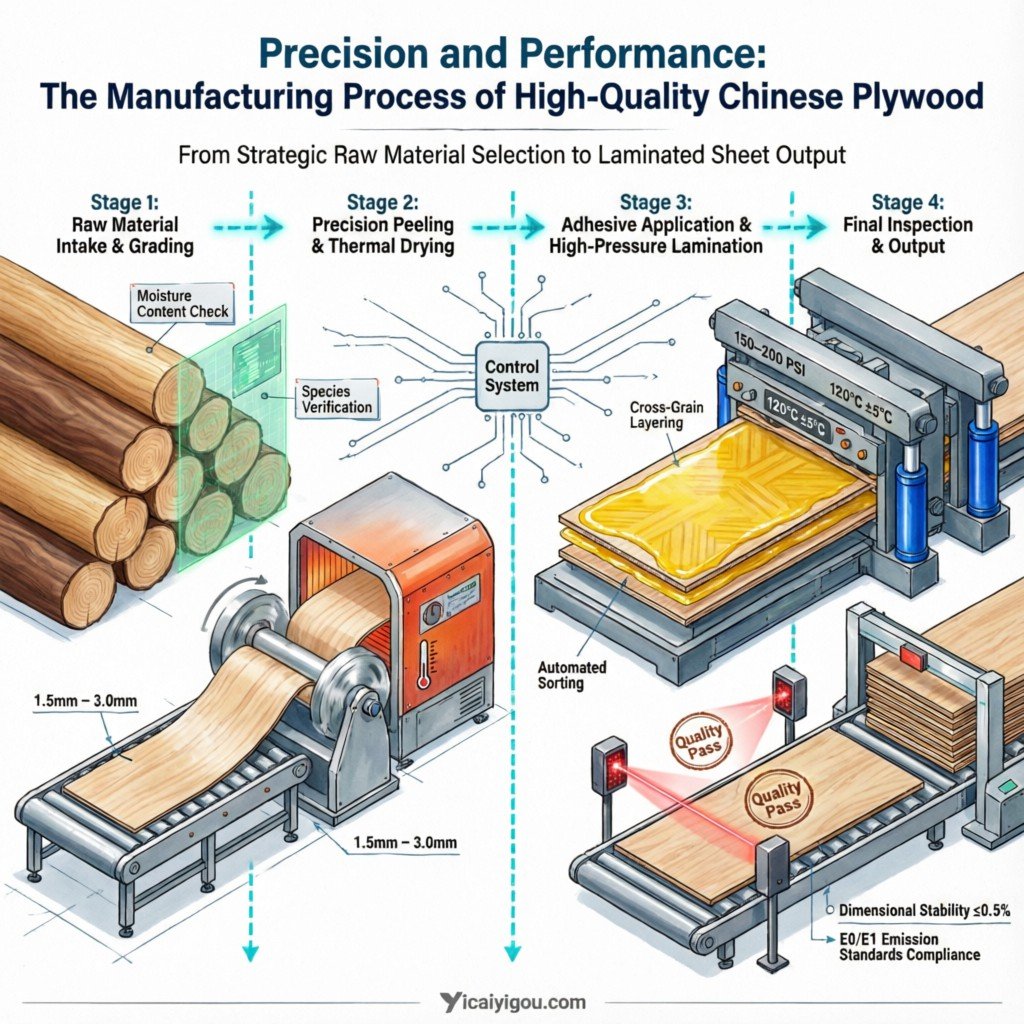
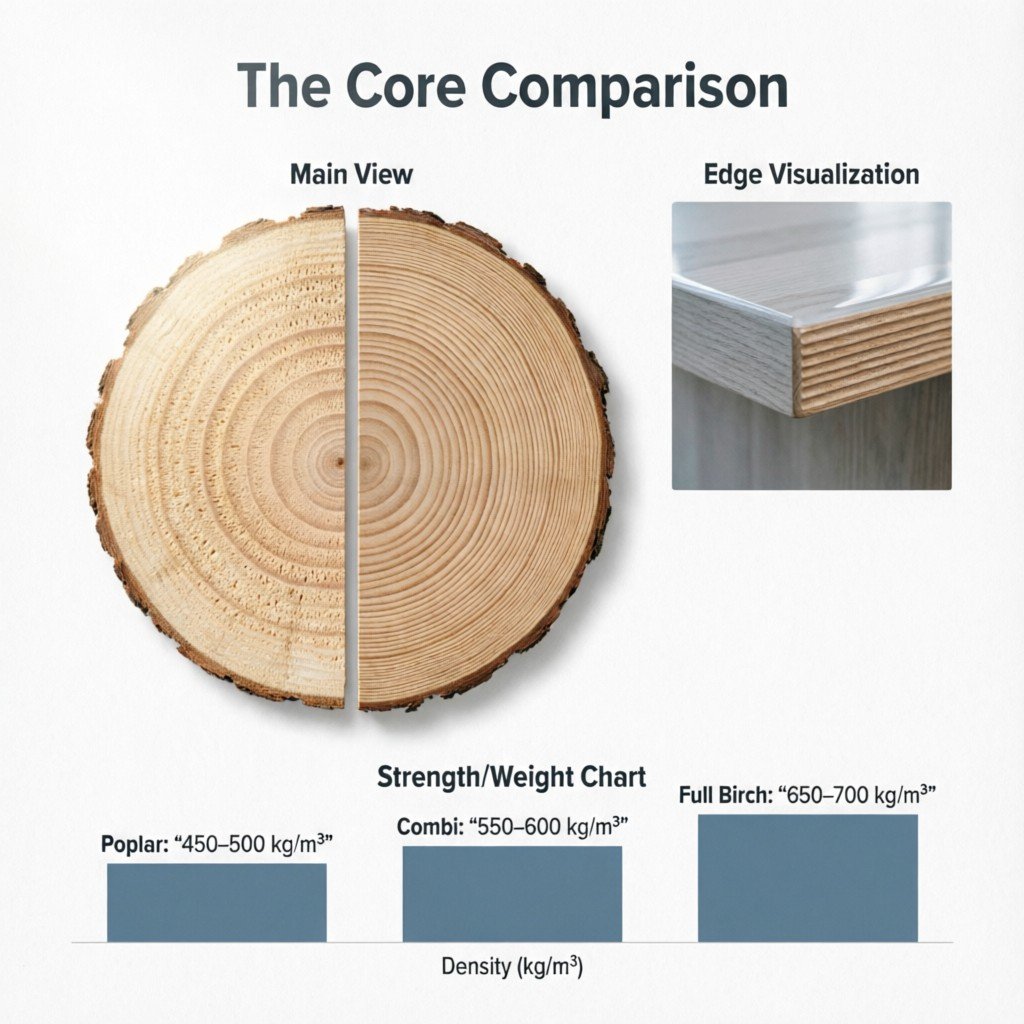
The foundation of durable plywood lies in the raw material. Reputable manufacturers in China prioritize sustainable forestry practices, sourcing logs primarily from fast-growing species such as Poplar, Eucalyptus, and Birch. These species are chosen for their uniform grain structure and favorable strength-to-weight ratios.
Upon arrival at the mill, logs undergo rigorous inspection. They are sorted by diameter and quality to ensure consistency across production batches. The preparation phase involves debarking and cutting logs into specific lengths suitable for the peeling lathe. Crucially, logs are often conditioned in water baths or steam vats. This softening process is vital; it reduces wood brittleness, minimizing veneer breakage during peeling and ensuring a smooth surface finish. Industry data suggests that proper conditioning can reduce veneer waste by up to 15%, significantly impacting overall efficiency and cost-effectiveness.
2. Veneer Peeling and Precision Drying
Once prepared, logs are mounted on rotary lathe machines. This is the heart of the plywood production process, where logs are spun against a stationary blade to peel continuous sheets of veneer. The thickness of these sheets is controlled with micrometer precision, typically ranging from 1.5mm to 2.5mm for core layers.
However, peeling is only half the battle. Moisture control is the single most critical factor in preventing delamination and warping. Freshly peeled veneer contains high moisture levels, often exceeding 80%. To achieve stability, veneers pass through multi-layer dryer machines. The target moisture content is strictly maintained between 8% and 12%. If the veneer is too dry, it becomes brittle and absorbs too much glue; if too wet, it risks blistering during pressing. Advanced manufacturers utilize automated moisture scanners to sort veneers in real-time, ensuring only material within the optimal range proceeds to assembly.
3. Adhesive Application and Core Assembly
The bonding agent determines the plywood’s environmental safety and durability. In the lumber industry, adhesive selection is dictated by the intended end-use. For interior furniture, Urea-Formaldehyde (UF) glue is common, but for exterior or marine applications, Phenolic resin is required for its water-resistant properties.
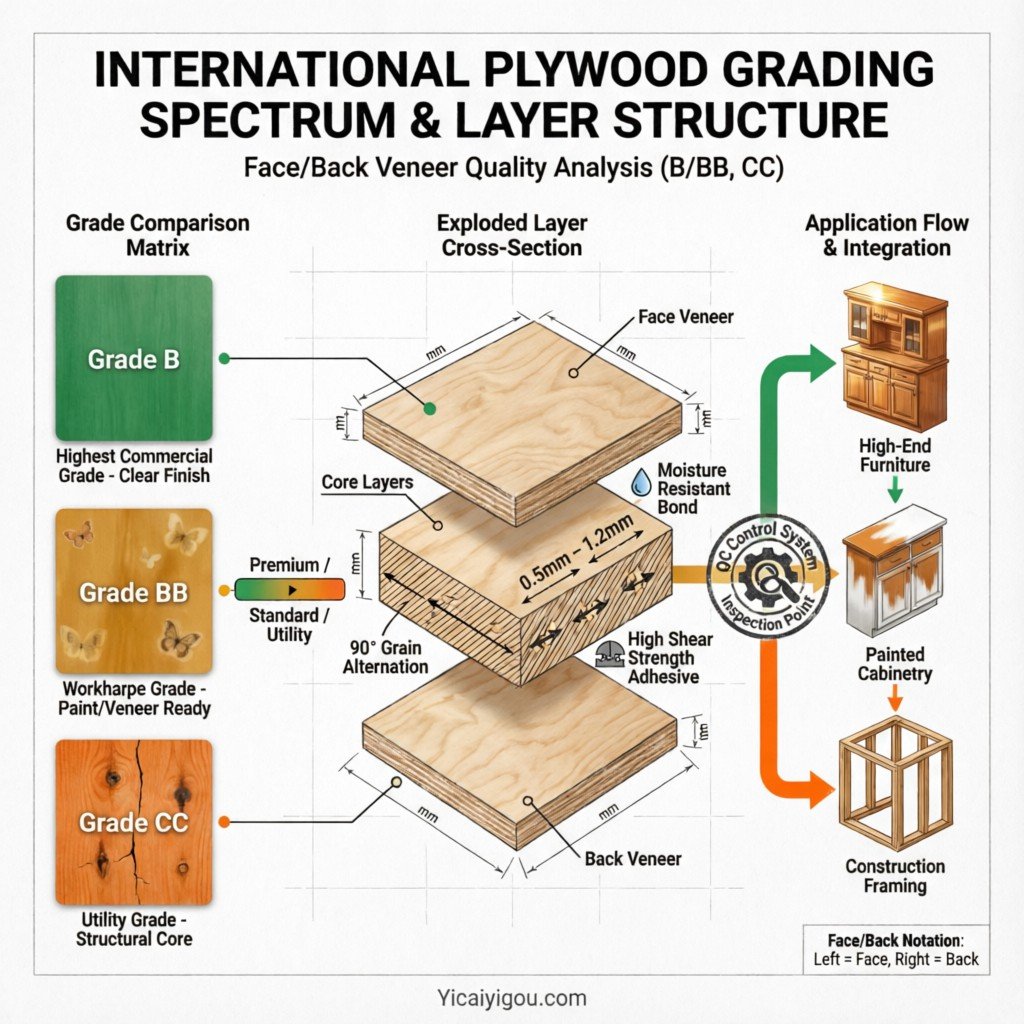
A major concern for international buyers is formaldehyde emission. High-quality Chinese manufacturers adhere to strict emission standards, producing boards classified as E0, E1, or CARB Phase 2 compliant. During the layup process, veneers are arranged with alternating grain directions (cross-graining). This orthogonal arrangement distributes stress evenly, preventing expansion and contraction due to humidity changes. Automated glue spreaders ensure an even coating, typically between 120 to 150 grams per square meter, preventing glue starvation or excessive squeeze-out that could weaken the bond.
4. Hot Pressing and Curing
Once assembled, the “wet” plywood panels enter the hot press. This stage transforms the layered veneers into a solid composite. The pressing parameters—temperature, pressure, and time—are calibrated based on the wood species and glue type. Typically, panels are subjected to temperatures around 110°C to 140°C under high pressure for several minutes.
This heat cures the adhesive, creating a permanent chemical bond. Modern hydraulic presses are equipped with sensors that monitor pressure distribution across the entire platen. Uneven pressure can lead to density variations, resulting in weak spots. After pressing, the panels are cooled and stacked to stabilize. This curing period is essential; rushing this step can lead to internal stresses that manifest as warping later in the supply chain.
5. Finishing, Quality Control, and Certification
The final phase distinguishes premium products from commodity goods. Panels are trimmed to standard sizes (e.g., 1220mm x 2440mm) and sanded to precise thickness tolerances, often within ±0.2mm. Visual grading follows, where inspectors check for core gaps, overlaps, and surface defects.
However, visual inspection is only part of the protocol. Leading facilities conduct laboratory testing for bonding strength, moisture resistance, and formaldehyde emission levels. Certification is the hallmark of trust. Buyers should look for FSC (Forest Stewardship Council) certification for sustainable sourcing, CE marking for European compliance, and CARB certification for the North American market. These certifications validate that the Chinese plywood manufacturing process meets global regulatory standards, mitigating risk for importers.
Conclusion
The journey from raw log to finished panel is a testament to industrial engineering. High-quality Chinese plywood is the result of meticulous raw material selection, precise moisture control, advanced adhesive chemistry, and rigorous quality assurance. For professionals in the wood products industry, partnering with manufacturers who transparently adhere to these technical standards ensures a supply of engineered wood that is both structurally sound and environmentally compliant.
As global demand for sustainable and durable building materials rises, the capability of Chinese manufacturers to meet these exacting standards positions them as vital partners in the global construction and furniture sectors.
Ready to Elevate Your Supply Chain?
Don’t compromise on the backbone of your projects. Partner with a manufacturer that prioritizes precision, compliance, and durability. Contact us today to request samples, verify certifications, and discuss how our premium plywood solutions can meet your specific project requirements. Secure your supply of high-quality engineered wood now.