Ensuring Excellence: 5 Critical Quality Control Checks Before Plywood Leaves the Factory
In the high-stakes world of the lumber and wood products industry, consistency is currency. For manufacturers, distributors, and construction professionals, the reliability of plywood determines the integrity of everything from residential framing to high-end cabinetry. A single batch of substandard material can lead to costly recalls, structural failures, and reputational damage. Therefore, implementing a rigorous plywood quality control protocol is not merely a regulatory requirement; it is a competitive advantage.
Before any sheet of engineered wood leaves the production line, it must undergo a gauntlet of inspections. These checks ensure compliance with international standards, such as ANSI/HPVA HP-1 or ISO 9001, and guarantee that the end-user receives a product capable withstanding environmental stress. Here are the five essential quality control checkpoints every facility must prioritize to maintain excellence in the lumber industry.
1. Moisture Content Analysis
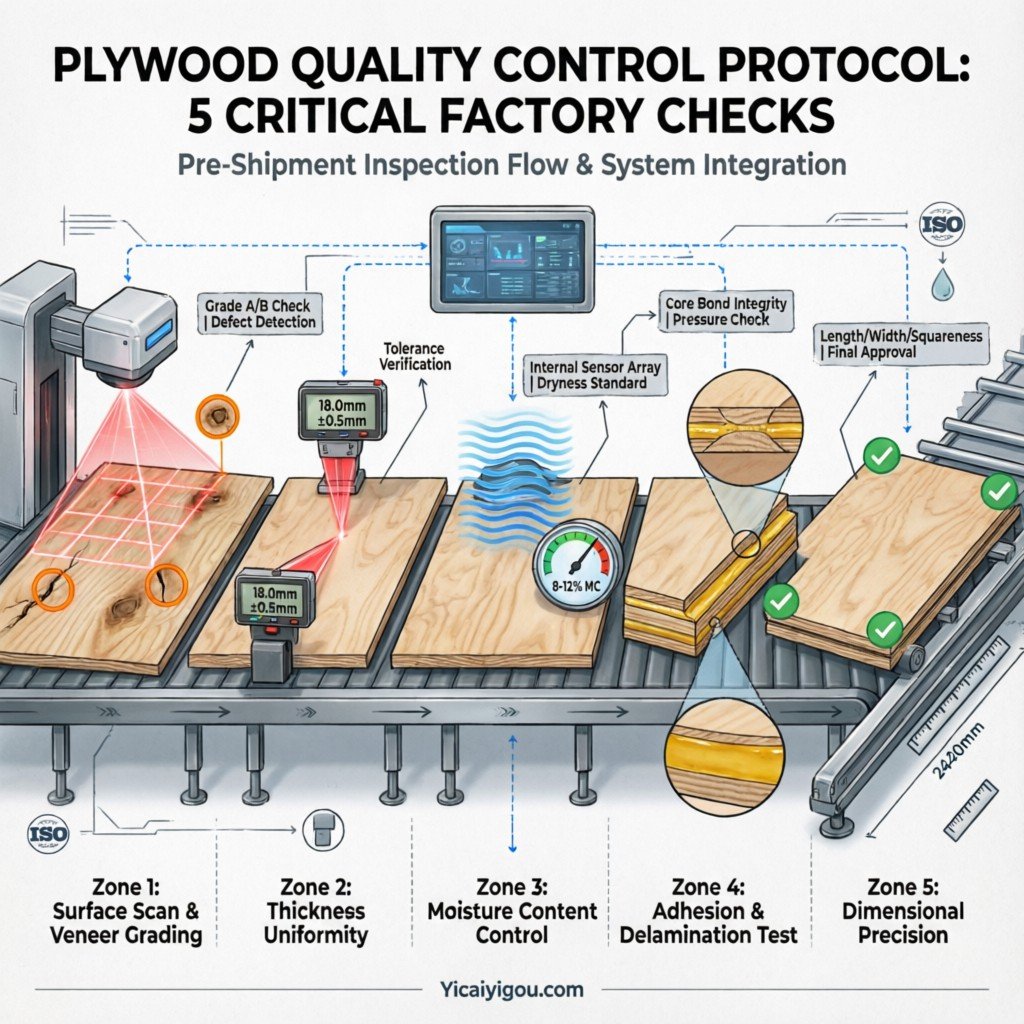
Water is the natural enemy of wood products. Improper moisture levels are the leading cause of warping, buckling, and mold growth after installation. During the manufacturing process, veneers are dried, glued, and pressed, but residual moisture can vary significantly across a batch.
Quality control managers must utilize pin-type or pinless moisture meters to sample sheets randomly from different stacks. The target moisture content typically ranges between 6% and 14%, depending on the intended environment and species. For interior-grade plywood, consistency is key; a variance of more than 2% between sheets can lead to differential expansion. Data suggests that maintaining moisture within a tight tolerance reduces customer returns by up to 30%. Ensuring equilibrium with the destination climate prevents post-installation failures, making this the first line of defense in wood products manufacturing.
2. Veneer Grade and Surface Quality
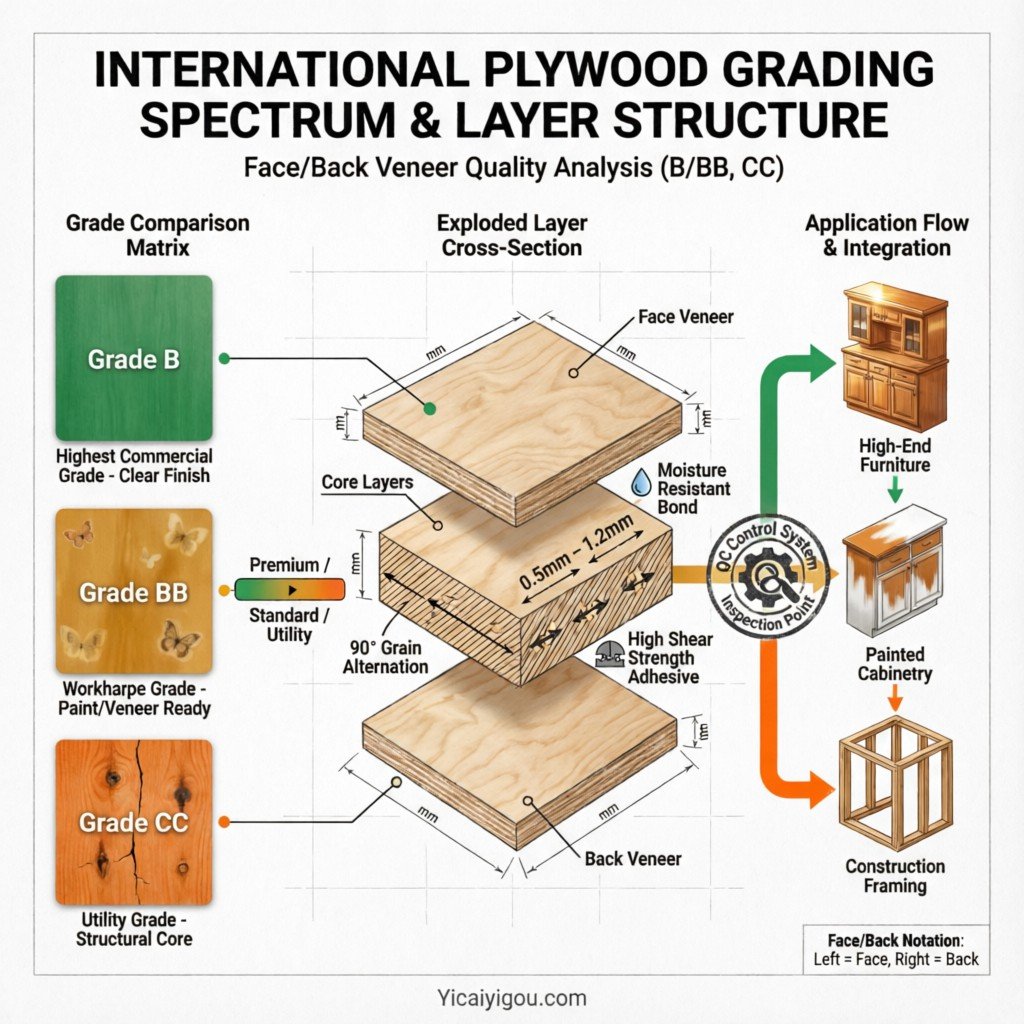
The aesthetic and structural value of plywood is largely defined by its face and back veneers. Whether the product is designated as A-grade for fine furniture or C-grade for structural sheathing, the surface must adhere to strict grading rules. QC inspectors look for defects such as loose knots, splits, patches, and sanding marks.
Advanced optical scanning systems are increasingly used alongside manual inspection to detect surface anomalies. For higher grades, repairs must be matched seamlessly with grain direction and color. Furthermore, the sanding process must be uniform; uneven thickness due to poor sanding can cause issues during CNC machining by the customer. By enforcing strict veneer grading standards, manufacturers ensure that the visual appeal matches the technical specifications, satisfying both architects and builders.
3. Bond Integrity and Delamination Testing
The heart of plywood’s strength lies in its adhesive bonds. If the glue lines fail, the layers separate, rendering the sheet useless. This is known as delamination, and it is often caused by insufficient glue spread, cold presses, or poor-quality adhesive.
To verify bond integrity, factories perform shear tests and boil tests on sample panels. In a standard boil test, samples are submerged in boiling water for several hours to simulate extreme humidity and heat, then examined for glue line failure. According to industry benchmarks, a high-quality structural plywood should maintain 100% wood failure rather than glue failure during these stress tests. Regular testing ensures the adhesive cures correctly under pressure, guaranteeing that the plywood can bear loads without separating over time.
4. Dimensional Accuracy and Thickness Tolerance
In modern construction and manufacturing, precision is paramount. Plywood sheets that deviate from standard dimensions can cause significant delays on job sites or in fabrication shops. A sheet nominally rated at 18mm (or 3/4 inch) must fall within specific tolerance limits, usually ±0.2mm to ±0.5mm depending on the standard.
QC teams use calibrated digital calipers and laser measurement tools to check length, width, and thickness at multiple points across the sheet. Squareness is also critical; sheets must be cut at perfect 90-degree angles to ensure tight joins. Consistent dimensional accuracy reduces waste for the customer and streamlines automated production lines. Manufacturers who prioritize tight tolerances build trust with high-volume buyers who cannot afford material variability.
5. Formaldehyde Emissions and Compliance Standards
Safety and regulatory compliance are non-negotiable in the modern lumber industry. Plywood adhesives, particularly those using urea-formaldehyde, can emit volatile organic compounds (VOCs) that pose health risks. Strict regulations, such as the California Air Resources Board (CARB) Phase 2 and the EPA TSCA Title VI, mandate low emission levels.
Before shipment, batches must be tested in certified chambers to measure formaldehyde release rates. Products intended for indoor use must meet E0 or E1 emission standards. Documentation accompanying the shipment must verify compliance to avoid legal liabilities for distributors and builders. By prioritizing formaldehyde emissions testing, manufacturers protect end-users and ensure their products can be sold in regulated markets globally.
Conclusion
Quality control in plywood manufacturing is not a single step but a continuous culture of precision. From monitoring moisture levels to verifying regulatory compliance, each checkpoint serves as a safeguard against failure. For industry professionals, understanding these five checks provides insight into what separates premium suppliers from the rest. For manufacturers, adhering to these protocols ensures longevity in a competitive market.
Investing in robust plywood quality control systems minimizes waste, protects brand reputation, and ultimately delivers a superior product to the market. In an industry built on natural materials, controlling variability is the key to unlocking consistent performance.
Ready to Elevate Your Supply Chain?
Don’t compromise on the foundation of your projects. Partner with a manufacturer that prioritizes rigorous testing and industry-leading standards. Contact us today to request a sample kit or schedule a factory audit. Let’s build a future on solid ground together.