Maximizing Cargo Volume: How to Fit 50+ Cubic Meters of Lumber in a 40HQ Container
In the global timber trade, logistics efficiency directly impacts profitability. For importers and exporters of lumber wood products, understanding how to optimize container space is not just a logistical necessity—it is a competitive advantage.
The 40-foot High Cube (40HQ) container is the industry standard for long-distance shipping, yet many businesses fail to utilize its full potential. Fitting 50+ cubic meters (CBM) into a single unit requires precise planning, technical knowledge, and strategic loading techniques.
This guide outlines the professional standards required to achieve high-volume utilization while maintaining cargo integrity.
Understanding the 40HQ Container Specifications
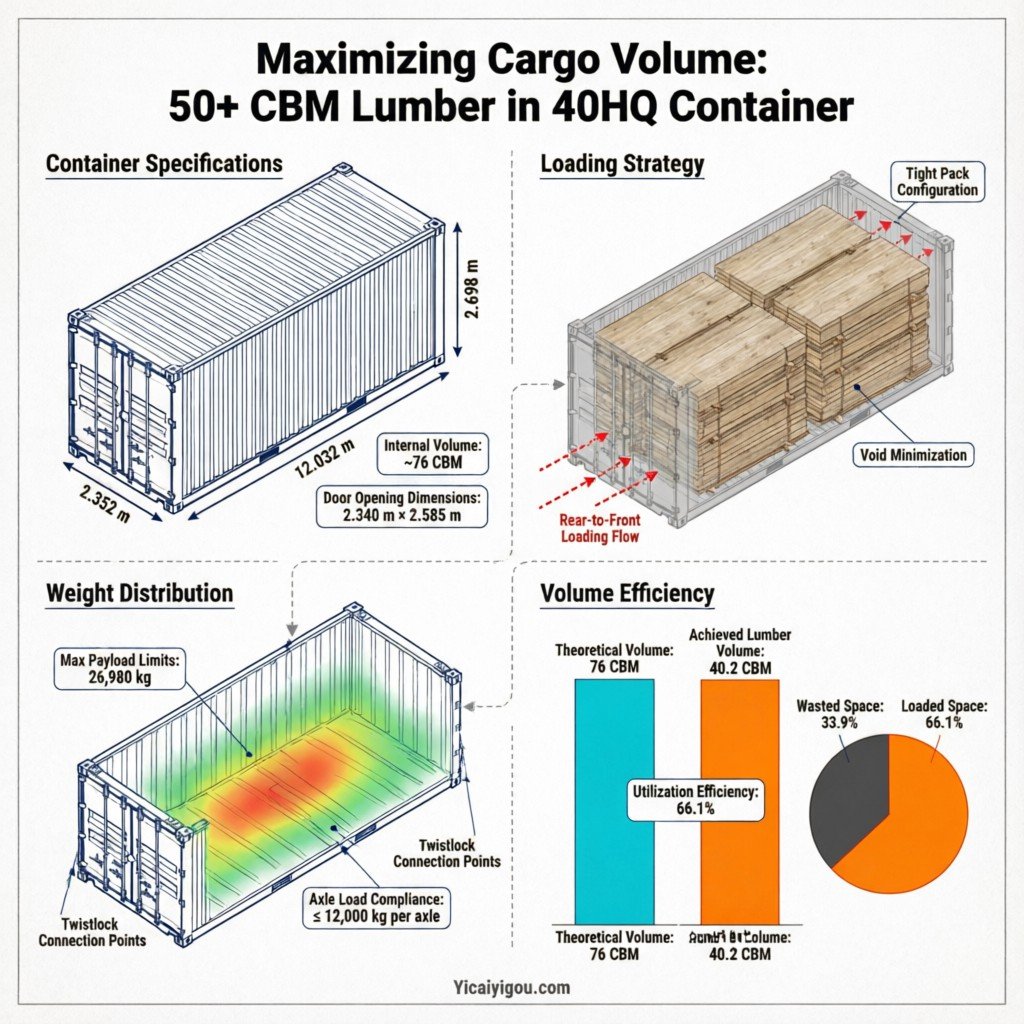
To maximize space, one must first understand the vessel. A standard 40HQ container offers greater vertical space than a standard 40-foot dry container, making it ideal for stacking bulky wood products.
- Internal Length: 12.03 meters
- Internal Width: 2.35 meters
- Internal Height: 2.69 meters
- Total Internal Volume: Approximately 76 CBM
- Maximum Payload: Typically 26,000 to 28,000 kg
While the theoretical volume is 76 CBM, practical loading capacity is lower due to packaging irregularities, pallets, and necessary airflow. Achieving a load of 50+ CBM is a realistic and efficient target for most seasoned lumber, but pushing toward 60+ CBM requires expert container capacity management without exceeding weight limits.
Balancing Volume and Weight Constraints
A common misconception in wood products logistics is that volume is the only constraint. In reality, weight often becomes the limiting factor before space runs out. Different wood species have varying densities. For example, loading 50 CBM of dense hardwood like Oak may exceed the maximum payload limit, whereas 50 CBM of softwood like Pine might leave unused weight capacity.
Professionals must calculate the stowage factor early in the procurement process. If the goal is 50+ CBM, the average density of the cargo should not exceed 500-550 kg per CBM to remain within safe road and sea transport limits. Overloading a container can lead to hefty fines, rejected shipments at ports, and safety hazards during transit. Therefore, accurate cubic meter calculation must always be paired with weighbridge verification before sealing the container.
Strategic Stacking and Loading Techniques
Fitting 50+ cubic meters efficiently requires more than simply pushing bundles into the box. It demands a methodical approach to stacking known as “block stacking” or “interlocking,” depending on the product format.
1. Uniform Bundling
Lumber should be packaged in uniform bundles. Irregular shapes create voids that waste valuable space. By standardizing bundle dimensions to fit the container’s width (2.35m), loaders can minimize gaps between the cargo and the container walls. Ideally, bundles should be arranged to allow two rows across the width with a small central aisle or tightly packed if the width permits.
2. Vertical Utilization
The defining feature of the 40HQ is the extra height (2.69m vs 2.39m in standard containers). To hit the 50+ CBM target, you must utilize this vertical space. Stack bundles evenly to prevent toppling. However, ensure the bottom layers can support the weight of the upper layers without crushing the wood fibers. Using stronger dunnage at the base can distribute weight more effectively.
3. Minimizing Pallet Footprint
While pallets facilitate forklift loading, they consume significant volume. For high-volume shipments aiming for maximum freight optimization, consider floor-loading (loose loading) where feasible. If pallets are necessary, use slim-profile heat-treated wooden pallets that comply with ISPM 15 standards to avoid quarantine issues.
Moisture Control and Dunnage Placement
Wood is a hygroscopic material, meaning it absorbs and releases moisture. During ocean freight, temperature fluctuations can cause “container rain,” leading to mold or warping. To protect 50+ CBM of inventory, proper dunnage is critical.
- Floor Protection: Never place lumber directly on the container floor. Use dry wooden strips or plastic sheets to create a barrier against moisture rising from the floor.
- Airflow Channels: Leave small gaps between bundles to allow air circulation. This prevents moisture buildup that can degrade lumber wood products during the 30-45 day transit typical of international shipping.
- Desiccants: Hang container desiccant bags from the ceiling hooks to absorb ambient humidity. This is a low-cost insurance policy for high-value cargo.
Securing the Load for Transit Safety
A fully loaded container is dangerous if the cargo shifts. A shift in 50 CBM of lumber can destabilize the vessel or cause the container doors to burst open upon arrival. Proper cargo securing is mandatory.
Use high-tensile lashing straps and dunnage bags to fill any remaining voids. The load should be tight enough that no bundle can move more than a few centimeters during heavy seas. Additionally, install locking bars across the doors internally. Before sealing, conduct a final inspection to ensure no nails or protruding wood elements could damage the container walls or injure personnel during unpacking.
Conclusion: Efficiency Drives Profitability
Mastering the art of loading a 40HQ container is about balancing physics, regulations, and economics. By successfully fitting 50+ cubic meters of lumber into a single unit, businesses reduce their cost per unit significantly, lowering the landed cost of goods and increasing margin potential. It requires attention to detail regarding weight distribution, moisture control, and secure stacking.
In an industry where freight rates fluctuate, maximizing every shipment is the most reliable way to control costs. Do not leave money on the table through inefficient packing.
Ready to Optimize Your Shipping Strategy?
Ensure your next shipment reaches its destination safely and cost-effectively. Partner with experts who understand the nuances of lumber shipping and container logistics. Contact us today for a consultation on optimizing your supply chain and maximizing your container utilization.